
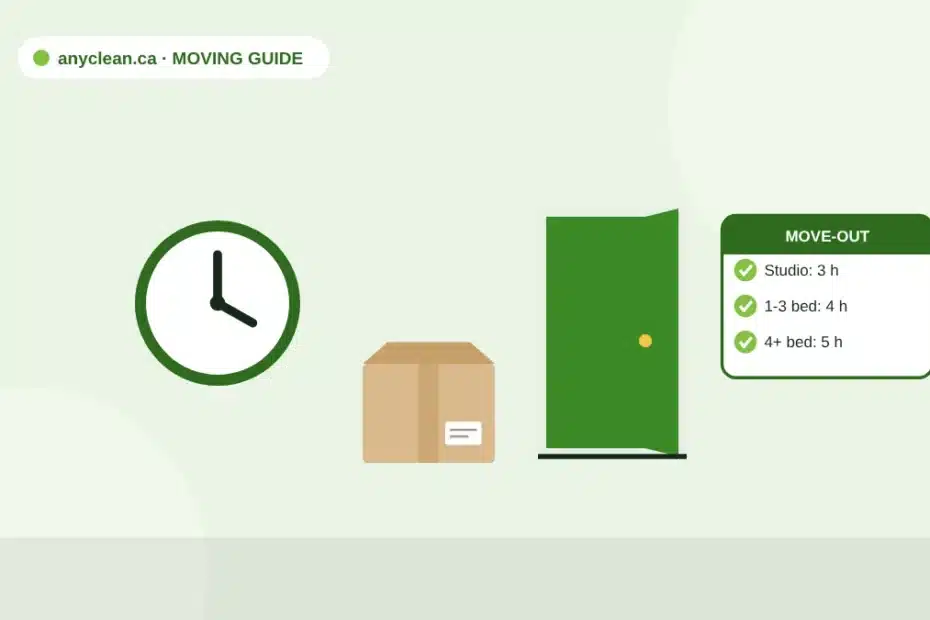
How Long Does a Move-Out Clean Take? Times by Home Size
Moving day already has too many moving parts. Here is how long a professional move-out clean actually takes, based on 2,510 move-out cleans our crews completed, what makes it longer, and how to fit it into your last day with the keys.
- Studio: about 3 hours. 1–3 bedrooms: about 4 hours. 4+ bedrooms: about 5 hours.
- Larger homes get more cleaners, not a longer day.
- Oven, fridge, walls and carpets add the most time.
- The unit must be empty: furniture and boxes left behind slow everything down.
- Book early for the last week of the month, when 42% of move-outs happen.
Move-out cleaning time by home size
| Home | Typical booked time | Typical price paid | Jobs |
|---|---|---|---|
| Studio | 3 h | $260 | 99 |
| 1 bedroom | 4 h | $325 | 525 |
| 2 bedrooms | 4 h | $420 | 598 |
| 3 bedrooms | 4 h | $558 | 586 |
| 4+ bedrooms | 5 h | $749 | 340 |
These are the time windows our crews book on site, from our own records. Times stay close to 4 hours for most sizes because we add cleaners as homes get bigger: a 3-bedroom house usually gets a larger crew rather than a longer day. The middle half of all move-out cleans took between 3 and 5 hours.
If you are cleaning it yourself
One person working alone should allow roughly two to three times the crew time: a full day for a 1- or 2-bedroom apartment, and more for a house with an oven, fridge and carpets to do. Most people underestimate the inside of cupboards, baseboards and the oven, which together can take as long as the rest of the unit.
What adds the most time
- Oven inside: about an hour for a heavily used oven, more with baked-on grease on the racks.
- Fridge and freezer inside: 30–45 minutes, longer if the freezer needs defrosting. Switch it off and defrost the night before.
- Walls: spot-washing scuffs and marks across a whole home can add an hour or more.
- Carpet steam cleaning: done after the rest of the clean, and needs 4–6 hours to dry.
- Items left behind: furniture, boxes and garbage have to be worked around or removed first.
- Balconies, garages and basements, if they are part of your lease.
How to plan move-out day
- Book as soon as you give notice. Month-end slots fill first, especially Fridays.
- Move out first, clean second. Book the clean for the afternoon of moving day or the next morning, before your final inspection.
- Leave power, water and lights on until the clean is finished.
- Defrost the freezer the night before.
- Leave a key or lockbox code if you can’t be there; you don’t need to wait in the unit.
- Book the inspection after the clean, and take dated photos for your records. Our crews send completion photos too.
What is included in that time
A move-out clean covers every room top to bottom: kitchen and bathrooms scrubbed and descaled, inside cupboards, drawers and closets, baseboards, doors, frames and switches, window sills and tracks, and floors vacuumed and mopped. Ovens, fridges, walls, interior windows and carpets are add-ons that you choose when you book. See the full cleaning checklist.
Frequently asked questions
How long does a move-out clean take for a 2-bedroom apartment?
About 4 hours with a professional crew, based on 598 two-bedroom move-out cleans in our records. Allow a full day if you are cleaning alone.
How long does a move-out clean take for a house?
A 3-bedroom house typically takes about 4 hours with a larger crew, and a 4+ bedroom house about 5 hours.
Do I need to be there during the move-out clean?
No. Most customers leave a key or lockbox code. We send completion photos when the job is done.
Should I clean before or after moving out?
After. A clean is faster and more thorough in an empty unit, and nothing gets dirty again while furniture is carried out.
Want it done for you?
Vetted, insured crews in Ontario, BC, Alberta, Saskatchewan, Manitoba, Nova Scotia and New Brunswick. Free 48-hour re-clean if anything is missed.
Get a free quoteSee pricesRelated guides
Sources
Our own figures come from AnyClean’s booking records: 5,684 completed jobs in seven provinces between May 2024 and October 2026. This guide is general information, not medical advice; for health concerns, speak to your doctor or local public health unit.